26 Oct, 2026
A Conversation on Moving People from Concern to Action: Introducing the Climate Ready Prairies Guide
The climate is changing across Alberta, Saskatchewan and Manitoba. Over the past three years, communities across the Prairies have experienced significant drought, flooding, and wildfire impacts. Although the nature and severity of impacts will vary across the region, these risks are expected to grow as the climate continues to change. The need to adapt has never been more important.
As more people experience climate-related events firsthand, public conversations about adaptation continue to compete with priorities such as affordability and national sovereignty. These discussions can also be shaped by emotional responses, polarization and misinformation, making an already complex topic more difficult to navigate.
As a strategy to provide guidance for communication where behavioural, social and cultural barriers to climate adaptation action may exist, ClimateWest partnered with Re.Climate and SevGen Consulting to deliver Climate Ready Prairies – a three-year research project and training program .
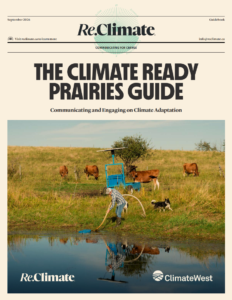
The Climate Ready Prairies Guide was created as the culmination of training sessions delivered across Alberta, Saskatchewan and Manitoba, extensive desktop research and interviews, and engagement with Indigenous leaders from across the region. Launched at Adaptation Canada 2026, the project released the PREPARE framework – a practical approach to climate adaptation communications and engagement; the Climate Ready Prairies Guide – a guide for communicating and engaging on climate adaptation; and supporting strategies, tools and case studies.
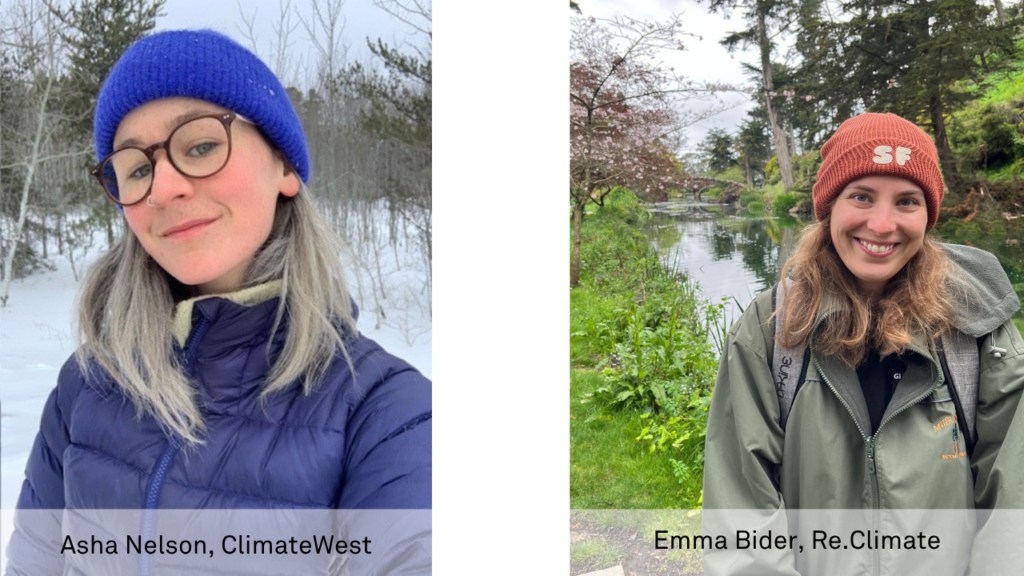
To celebrate this major milestone, we sat down with the project leads, Asha Nelson from ClimateWest and Emma Bider from Re.Climate to discuss the guide and the work behind its development.
This discussion has been edited and condensed.
Tell us more about the Climate Ready Prairies Guide. Who is the intended audience? How is it different from other research and guidance on the subject?
Emma: The Climate Ready Prairies Guide is really the culmination of all the research, interviews, and engagement we did throughout this project. It is meant to provide prairie-based communicators and anyone responsible for engaging the public on adaptation with grounded research, tools and stories on how to best approach this work.
In terms of how this guide is different, I would say first, adaptation communication is still an emerging area of inquiry. Until recently, much of the climate communications research has focused on mitigation, which, as we’ve found, requires quite a different response. There is also very little research examining adaptation communication in the Prairies.
Asha: I might add that when we started this project, there were a handful of people who wanted this guide to tell them the exact words they should use to create buy-in for climate adaptation in the region. However, what we found is that while messaging is important, there is so much more that needs to be considered beforehand. What is your existing relationship with your audience? Who should be delivering that message?
Emma: That’s a really important point! It’s not like, what are the perfect words. It’s more like, do people feel like they have a say in what’s happening? And how do you make people trust that the work you’re doing is actually going to make their lives better?
What is the PREPARE Framework? What is one element that stands out for you?
Emma: The PREPARE Framework is something we came up with after reviewing all the research, engagement and training we had delivered. We asked ourselves what is necessary to build long term public support for adaptation actions? The framework is a response to that question.
 |
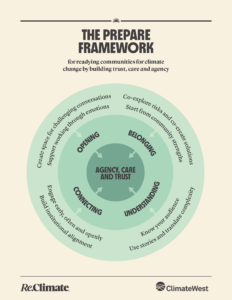 |
We see it as a circle with three rings. At the centre, is what we believe the public needs to meaningfully engage in adaptation: agency, care and trust. The second ring focuses on the capacities communicators should foster which will lead to this sense of agency, care, and trust. And then the outer ring represents the practices and tools that can help build those capacities.
In terms of which of the framework elements stands out to me most, I would have to say the capacity of “Opening.” I think many adaptation practitioners feel wary of engaging directly with the public because of the potential for heated emotions. But what we’ve learned is that if we don’t give people space to express and work through those emotions, they can continue to fester and make people more resistant to change. We need to ask ourselves: How can we create safe spaces for difficult conversations? And what are some of the positive emotions we can tap into to help keep the places and people we love safe?
How do local perspectives from the region show up in the guide? And why was it important?
Asha: From the very start of this project, it was important to us to learn from the people on the ground having these difficult conversations and successfully building community support for adaptation. Given climate adaptation requires a whole-of-society approach, we specifically sought expertise across diverse sectors and institutions, including municipalities, agricultural organizations, watershed associations, and emergency management departments, to name a few.
The perspectives and experiences of climate adaptation practitioners and communicators helped shape the Framework. But their stories also show up in examples and case studies that are weaved throughout the guide. This was important because people are more likely to trust guidance if they can actually see themselves reflected in it. In fact, one of the practices in the guide emphasises the value of drawing from local knowledge.
I also think it’s important to highlight and celebrate the important work happening here, as our contributions are often missing from national conversations. We want people to come away from the guide feeling proud of the people, places and culture that makes this region so special. As we’ve found, pride and love of place is a huge motivator for adaptation work.
What are some key insights you gained from engaging Indigenous leaders?
Asha: We learned so much through the Indigenous engagement process and I’m grateful to the team at SevGen for helping to facilitate these connections. For one, the term “adaptation” doesn’t necessarily resonate with everyone. Indigenous Peoples have been adapting for millennia. Instead, many people prefer conversations grounded in lived experience and balance.
I would also say that climate adaptation is understood as much more than simply protecting homes and critical infrastructure. It’s about cultural continuity, ecological stewardship, self-determination, and caring for future generations. You can see this in the many examples of Indigenous-led adaptation, such as Sioux Valley Dakota Nation’s bison rematriation efforts or Flying Dust First Nation’s agricultural program.
Emma: Exactly! I think that’s why there’s a strong emphasis on bringing youth into climate adaptation initiatives. We heard example after example of deliberately engaging young people because they will be the people taking this work on. This is just one example of some of these insights we tried to incorporate into the guide.
I might add that while we engaged representatives from 15 Nations and organizations, we barely scratched the surface. We don’t pretend the guide perfectly captures the multitude of experiences and perspectives of Indigenous people in the region. In many ways, this is only the start of our journey as organizations towards meaningful engagement, and working alongside and highlighting the work and knowledge of Indigenous leaders in this space. We look forward to continuing this work in the years to come.
Ultimately, what do you hope readers take away from the guide?
Asha: I would say for me, it’s all about slowing down. We need to be careful to not allow a sense of urgency to push us to rush through our engagement with the public. If we do, we run the risk of our work fuelling more frustration, more fear, more paralysis.
So, I would challenge those who read the guide to slow down where it matters, to take time for reflections and relationship building where you can. We know it’s difficult. We’re not saying there are ten steps that will lead to success. But what are some small changes you can make now to help build agency, care and trust?
Emma: I hope that people reading the guide feel inspired to reach out to ClimateWest, for example, and say, “Hey, can you put me in touch with this person?” In that sense, we see the guide as a living document, one where the conversations carry on and we keep sharing everything we’re learning. Because we’re all still learning and trying new things. I think that’s exciting.
To access the Climate Ready Prairies Guide and supporting materials, click here.
Want to connect with any of the organizations featured in the guide? Reach out to ClimateWest at info@climatewest.ca
To learn more about the Climate Ready Prairies project, watch this short video.